China’s automotive supply base has become difficult to overlook. The International Organization of Motor Vehicle Manufacturers reported that China produced more than 30 million vehicles in 2023. That scale supports a deep network of mirror factories, molding suppliers, coating specialists, and export distributors. It also creates noise. Not every factory advertising an Adjustable Alto Door Mirror has the same engineering capability.
This guide examines ten Chinese manufacturers linked to Suzuki Alto-compatible door mirrors and related replacement products. The assessment considers fitment accuracy, mirror adjustment range, glass clarity, housing durability, tooling control, certifications, and export experience. These details matter when a mirror must align with the door skin, hold position on a rough road, and remain clear under rain. Grand View Research’s automotive mirror market analysis highlights growing demand for safety-focused replacement and upgraded mirror systems. MarketsandMarkets also identifies electronic adjustment, heating, and integrated signaling as important product directions. However, Alto applications may remain strongly price-sensitive in many markets.
Factory evidence matters more than polished catalogs. Product samples, inspection records, ISO 9001 documentation, test procedures, and responsive technical communication deserve careful review. A low quoted price can hide inconsistent clips or distorted glass. That is an uncomfortable point. Supplier rankings are never permanent. Models, tooling, and quality systems change. This article therefore presents a practical comparison, not an unquestionable verdict, helping buyers identify reliable Adjustable Alto Door Mirror manufacturers for wholesale, distribution, and aftermarket sourcing.
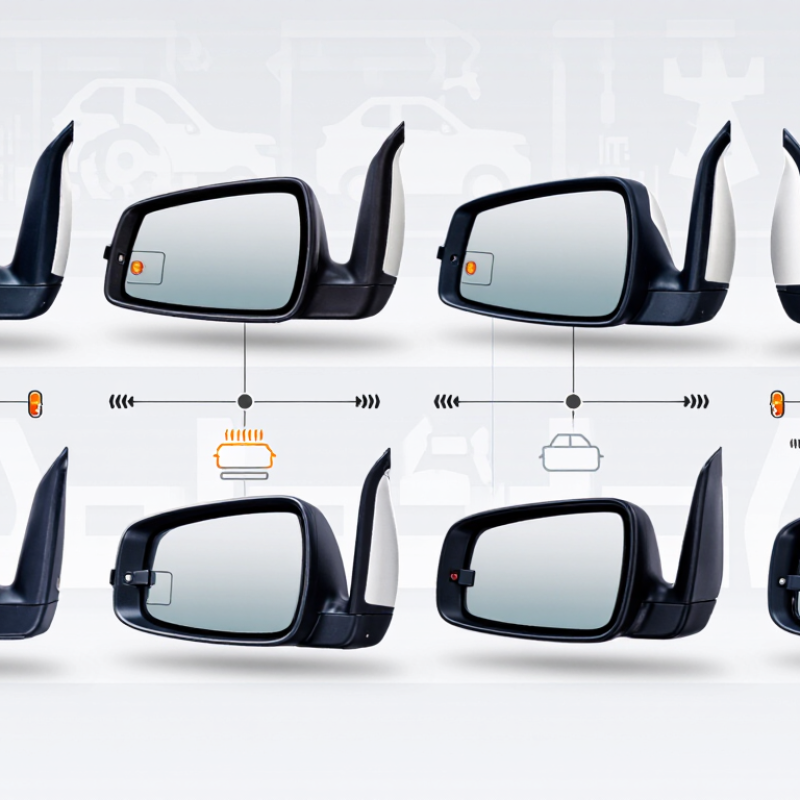
What Are Adjustable Alto Door Mirrors?
What Are Adjustable Alto Door Mirrors?
Adjustable Alto door mirrors are exterior viewing units designed for a compact Alto vehicle. They help drivers monitor nearby traffic, parked objects, and lane edges. “Adjustable” usually means the glass angle can be changed manually or through an interior control. Some assemblies use a small joystick, while others use an electric actuator. The housing also protects the glass from rain, dust, and minor contact.
A properly adjusted mirror shows only a narrow section of the vehicle’s side. Most of the glass should display the adjacent lane and surrounding road. Convex glass can widen the view, but it may make vehicles appear smaller. That difference can affect distance judgment. A small blind spot remains.
From practical fitting experience, compatibility requires more than matching the vehicle name. Check the model year, mounting holes, connector shape, mirror-control system, and left- or right-hand position. Heated glass may also require the correct wiring. The fold mechanism should move smoothly without excessive looseness. A mirror can look correct and still fail to fit securely. This detail is often overlooked. Reliable manufacturers normally verify dimensions, glass clarity, actuator movement, and impact resistance through documented quality checks. Installation should follow the vehicle’s service guidance, with fasteners tightened evenly. The word “Alto” is not perfectly consistent across every market, so precise vehicle information matters before ordering.
How to Evaluate Chinese Alto Door Mirror Manufacturers
Evaluating Chinese Alto door mirror manufacturers requires more than comparing catalogue prices. The China Association of Automobile Manufacturers reported 31.28 million vehicles produced in 2024. This scale supports strong tooling, molding, and export experience, but it does not guarantee consistent mirror quality. Request a factory audit, production flow chart, and recent inspection records. Check whether the supplier controls plastic injection, glass fitting, actuator assembly, and final adjustment under one system.
Fitment evidence matters most. Ask for dimensional drawings, mounting-point tolerances, connector diagrams, and samples from different production batches. Test manual or electric adjustment through repeated cycles, then inspect vibration, folding resistance, glass clarity, and color consistency. For export markets, verify testing against UNECE Regulation No. 46 or applicable FMVSS No. 111 requirements. These standards address rear visibility and mirror performance, yet compliance claims should come from traceable laboratory documents, not screenshots.
IATF 16949 certification can indicate automotive process discipline, while ISO 9001 alone is not enough. Review corrective-action records and supplier-control procedures. A serious manufacturer should explain its PPAP approach, material grades, salt-spray results, and warranty data. Ask for serial-number traceability. Small details expose weak control. However, one factory visit can mislead; production may improve temporarily. Independent pre-shipment inspection remains worthwhile. The overlooked risk is packaging: a correctly adjusted mirror can still arrive with cracked glass or distorted housings.
China’s Top 10 Adjustable Alto Door Mirror Manufacturers
China’s Top 10 Adjustable Alto Door Mirror Manufacturers deserve careful comparison, not simple ranking. China’s Association of Automobile Manufacturers reported 31.28 million vehicles produced in 2024. That scale supports strong tooling, molding, and automotive component expertise. However, Alto-compatible mirrors require precise fitment, stable adjustment, and dependable folding resistance. A large factory does not automatically deliver consistent quality.
The strongest manufacturers usually provide ABS or reinforced polymer housings, clear optical glass, corrosion-resistant fasteners, and tested pivot joints. Their quality systems may follow IATF 16949 or ISO 9001 procedures. The International Organization of Motor Vehicle Manufacturers reported global production above 93 million vehicles in 2023, highlighting intense supply-chain pressure. Buyers should request inspection records, sample approval, adjustment-cycle results, and salt-spray data. Small dimensional errors can create vibration at highway speed. That detail matters.
Tips: Check mirror dimensions against the original part. Confirm left-hand or right-hand traffic compatibility. Ask for photos of the mounting plate, connector, and adjustment mechanism. A ranking can be imperfect. Production batches may differ, and online specifications sometimes remain outdated. Independent pre-shipment inspection adds useful evidence before payment. Safety-related claims should rely on test documents, not attractive product descriptions.
China’s Top 10 Adjustable Alto Door Mirror Manufacturers
This chart presents a practical 100-point screening framework for comparing the top 10 adjustable Alto door mirror manufacturers. The scores represent procurement weights rather than company-specific ratings, emphasizing fitment accuracy, adjustment performance, durability, weather resistance, and warranty documentation.
Key Differences in Products, Quality, and Production Capabilities
China Top 10 Adjustable Alto Door Mirror Manufacturers
When comparing China’s top ten adjustable alto door mirror manufacturers, product design reveals the first major difference. Some suppliers offer manual adjustment, while others provide electric control, heating, or integrated turn signals. A mirror should move smoothly without excessive play. Check the mounting bracket, glass curvature, housing fit, and cable routing. Small gaps often become noisy at highway speeds.
Quality depends on more than appearance. Experienced factories usually control plastic molding temperature, coating thickness, glass alignment, and final adjustment force. Reliable suppliers can provide material certificates, inspection records, and sample test reports. Ask how they test vibration, corrosion, water entry, and repeated folding. A mirror that survives repeated adjustment matters more than a polished catalog photograph. Some factories inspect every unit. Others inspect by batch, which may increase variation.
Production capability separates established manufacturers from smaller workshops. Automated molding equipment can improve consistency, but skilled workers still matter during assembly and calibration. Look for stable tooling, spare-parts planning, and clear production traceability. Capacity figures need careful review. A factory claiming high monthly output may rely heavily on subcontractors. That is not always poor, but it deserves verification. In my experience, honest suppliers explain their limits, including mold changes, peak-season delays, and imperfect first samples. Buyers should test several production units, not only one approved prototype.
How to Choose the Right Manufacturer for Your Needs
China Top 10 Adjustable Alto Door Mirror Manufacturers: How to Choose the Right Manufacturer for Your Needs
Choosing among China’s top ten adjustable Alto door mirror manufacturers requires more than comparing unit prices. OICA reported approximately 93.5 million motor vehicles produced worldwide in 2023. That scale increases pressure on suppliers, especially for stable fit, clear visibility, and repeatable adjustment. Request dimensional drawings, mounting-point tolerances, glass curvature data, and adjustment-angle test records before sampling. A mirror that looks correct may still vibrate at highway speed.
Compliance should guide your shortlist. UNECE Regulation No. 46 covers indirect-vision devices, while FMVSS 111 applies to mirror visibility requirements in the United States. Ask whether the manufacturer can provide test reports, material traceability, and production records linked to each batch. ISO 9001 certification helps, but it does not replace product-specific testing. Check the certificate scope and issuing body. Small details matter.
Production capability is equally practical. Visit the assembly line, or request a live video audit. Inspect glass edges, actuator movement, wiring protection, and packaging corners. The China Association of Automobile Manufacturers reported over 31 million vehicle sales in 2024, showing the country’s substantial automotive manufacturing capacity. Yet capacity alone proves little. A supplier may quote attractive prices and still miss color matching or delivery dates. I would score ten candidates on quality evidence, tooling control, warranty response, and communication speed. My scoring may be imperfect, but written evidence is safer than confident promises.
FAQS
Request factory records, production-flow charts, dimensional drawings, and recent inspection reports. Ask for samples from different production batches. One sample can flatter reality.
Check mounting-point tolerances, connector diagrams, glass curvature, and housing dimensions. Install several samples on the target vehicle. Look for loose brackets, uneven gaps, and difficult cable routing.
Test manual or electric adjustment through repeated cycles. Inspect folding resistance, glass clarity, vibration, and color consistency. The movement should feel smooth, not stiff.
Ask for material certificates, coating records, salt-spray results, warranty data, and corrective-action reports. Serial-number traceability is useful. Paperwork can still be incomplete, so compare records with physical samples.
No. It shows general quality-system control, but product-specific testing remains necessary. Automotive process certification can provide stronger evidence. Check the certificate scope and issuing organization carefully.
Request traceable laboratory reports for the destination market. Verify testing for rear visibility, adjustment performance, and mirror durability. Screenshots are weak evidence.
Review molding equipment, tooling maintenance, assembly skills, and spare-parts planning. Ask whether production is handled internally or through subcontractors. High capacity numbers need verification.
Check glass protection, housing support, corner padding, and carton compression resistance. A correctly adjusted mirror may still arrive cracked. Packaging deserves its own inspection.
Test several units from separate batches, not only one approved prototype. Repeat adjustment, vibration, water-entry, and folding checks. My scoring method may miss hidden variation.
Conclusion
This guide presents a practical overview of the China Top 10 Adjustable Alto Door Mirror Manufacturers, focusing on how buyers can understand products, compare suppliers, and select the right production partner. It first explains what an Adjustable Alto Door Mirror is, including its adjustable structure, visibility benefits, installation requirements, and suitability for different vehicle applications. It then outlines key evaluation criteria such as manufacturing experience, material quality, optical performance, adjustment mechanisms, customization options, certifications, quality control, delivery capacity, and after-sales support.
The comparison of the top ten manufacturers is organized around product design, production capabilities, technical resources, consistency, pricing, and service responsiveness rather than brand recognition alone. By examining differences in quality standards, factory capacity, sample development, packaging, lead times, and order flexibility, readers can identify suppliers that match their specific needs. The final section offers a clear selection framework for wholesalers, distributors, fleet operators, and vehicle equipment buyers seeking reliable Adjustable Alto Door Mirror production.