1. Commercial Vehicle Side Mirror Architecture: OEM Technical Insights & Supply Chain Requirements
In modern commercial logistics and transportation fleets, the Commercial Vehicle Side Mirror serves as an indispensable active safety component. Unlike standard passenger vehicle mirrors, commercial mirrors operate under severe structural stresses, including prolonged diesel engine vibration, aerodynamic turbulences at highway speeds, extreme ambient temperature fluctuations, and frequent mechanical impacts during urban maneuvering. Technical buyers, fleet operations managers, and international automotive parts distributors require detailed engineering criteria when selecting commercial vehicle side mirror suppliers.
From an engineering standpoint, a commercial vehicle side mirror assembly must fulfill dual responsibilities: maximizing the driver's lateral and rearward Field of View (FOV) in accordance with global regulatory mandates (such as UNECE Regulation 46 Class II to VI and US FMVSS 111), while simultaneously maintaining high structural rigidity and optical clarity over hundreds of thousands of kilometers.
Key Technical Definition: Commercial Rear-Vision Classifications
Commercial vehicle vision systems are categorized by vision class. Primary side mirrors (Class II & III) handle long-range rearward visibility. Wide-angle secondary mirrors (Class IV) reduce blind spots along lower cargo bodies, while proximity close-proximity mirrors (Class V) and front mirrors (Class VI) protect pedestrians in urban delivery zones. Selecting the proper radius of curvature ($R1200$ to $R1800$ for primary, $R300$ to $R400$ for wide-angle) is critical for preventing spatial perception distortion.
At Sanyo Industries (India), established in 1994, our engineering team has spent over 30 years refining the manufacturing metallurgy, injection molding precision, and glass silvering techniques required to produce commercial vehicle side mirrors that pass rigorous physical and optical benchmarks.
2. High-Performance Commercial Vehicle Side Mirror Product Catalog
To assist global procurement managers in selecting exact fitments, we present our core commercial vehicle side mirror product lines, engineered specifically for high-volume commercial vehicle platforms including Tata Motors, Mahindra & Mahindra, Eicher/Mitsubishi Canter, and Swaraj Mazda.
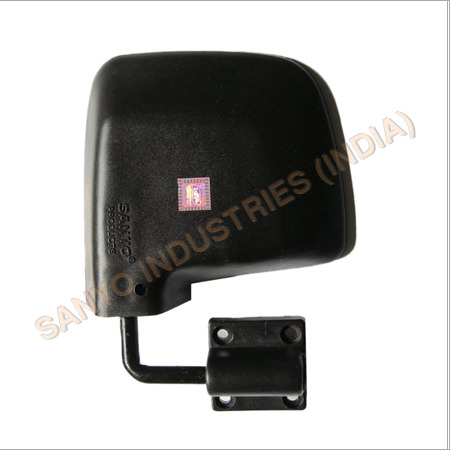
Automotive Tata Ace Side Door Mirror
Heavy-duty side mirror tailored for small commercial vehicle (SCV) urban fleets. Engineered for tight maneuverability and high shock resistance.
Get a Quote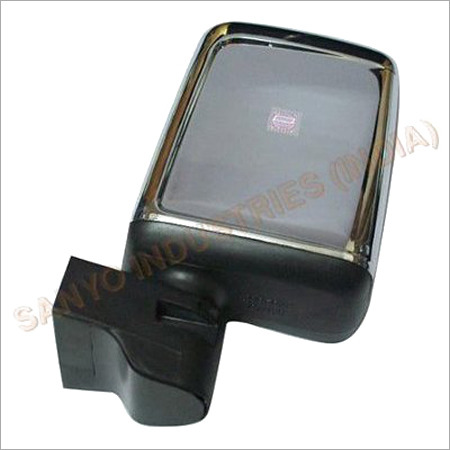
Mahindra Bolero Commercial Side Mirror
Reinforced side door mirror for utility commercial vehicles and light trucks operating in rugged rural and construction terrains.
Get a Quote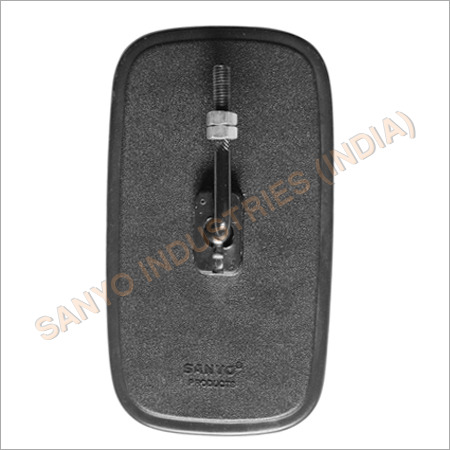
Door Mirror Canter Commercial Truck
Medium-duty truck mirror housing designed for Mitsubishi Canter and Eicher commercial platforms. Features extended vision field.
Get a Quote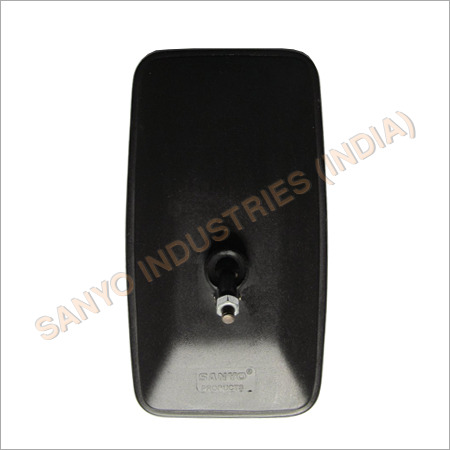
Door Mirror Swaraj Mazda Commercial
Rugged outer rearview mirror engineered for buses, commercial haulers, and regional distribution trucks requiring long-reach arms.
Get a Quote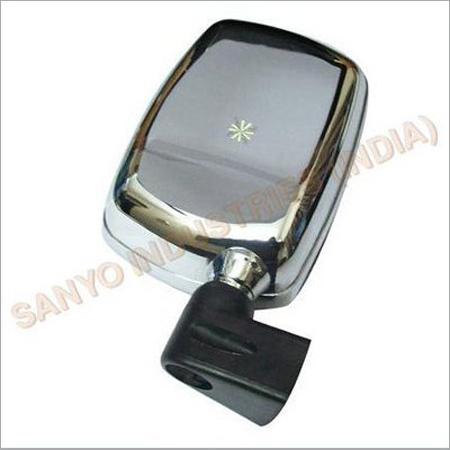
Door Mirror Bolero Chrome Edition
Premium electroplated chrome commercial mirror. Offers superior corrosion protection against salt spray and coastal ambient moisture.
Get a Quote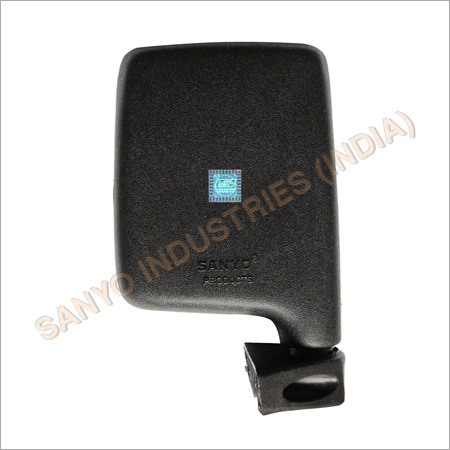
Universal Four-Wheeler Commercial Side Mirror
Versatile aftermarket commercial mirror engineered for light delivery vans, multi-utility vehicles (MUVs), and commercial taxi fleets.
Get a Quote3. Technical Specifications & Material Matrix
Commercial fleet operations require component reliability. The matrix below outlines how materials, mirror coatings, and bracket structural engineering directly impact the longevity of a Commercial Vehicle Side Mirror.
| Engineering Attribute | Standard Passenger Car Mirror | Heavy-Duty Commercial Vehicle Side Mirror | Sanyo Industries Technical Standard |
|---|---|---|---|
| Housing Polymer | Standard Recycled ABS / Polypropylene | Virgin High-Impact ABS / Mineral-Filled Nylon | UV-Stabilized Virgin ABS (V-0 Flame Retardant Grade) |
| Vibration Damping | Light Internal Springs | Internal Rib Structural Grid & Rubber Dampers | Dual-Spring Torque Mechanism + Reinforced Core Ribs |
| Mirror Glass Type | Standard Aluminum-Coated Glass | High-Reflectivity Silver Coated Glass | First-Surface Silvered Float Glass (R1400 / Flat Optics) |
| Operational Thermal Range | -10°C to +60°C | -30°C to +75°C | -40°C to +85°C (Zero Warp or Micro-Cracking) |
| Corrosion Resistance | 24-48 Hours Salt Spray | 72 Hours Salt Spray Compliance | > 96 Hours Neutral Salt Spray (NSS) ASTM B117 |
4. Global Procurement Trends in Commercial Vehicle Rear-Vision Systems
The global commercial automotive industry is undergoing rapid technological transitions driven by fleet electrification, telematics integration, and stringent safety legislation. B2B buyers must align their procurement strategies with four key future trends in commercial vehicle side mirrors:
A. Integration of Camera Monitor Systems (CMS) & Hybrid Mirror Configurations
While digital mirrors (CMS using side-mounted cameras and cabin displays) are emerging in premium long-haul trucks, global procurement data indicates that hybrid mirror architecture is dominating mainstream commercial procurement. Hybrid setups combine physical heavy-duty side mirrors with integrated wide-angle blind-spot cameras. Physical side mirrors remain non-negotiable because they provide immediate fail-safe optical visibility without risk of latency, electronic system failures, or screen glare under direct sunlight.
B. Total Cost of Ownership (TCO) & Modular Replacement Design
Fleet operators no longer accept single-piece sealed side mirror assemblies that require complete replacement following minor side-swipe collisions. Modern procurement demands modular commercial vehicle side mirrors—wherein glass plates, outer housings, lower blind-spot lenses, and mounting stalks can be independently serviced. Sanyo Industries designs modular mirror assemblies that reduce fleet maintenance turnaround times by 65% and cut long-term spare-parts expenditure.
C. Lightweighting & Aerodynamic Drag Reduction
Fuel efficiency and battery range in Commercial Electric Vehicles (CEVs) are heavily affected by external aerodynamic drag. Commercial side mirrors account for approximately 2% to 5% of a truck’s total aerodynamic resistance. Future-focused procurement prioritizes aerodynamic housing contours (optimized via Computational Fluid Dynamics - CFD) paired with low-density, glass-filled composite plastics that reduce overall vehicle curb weight without compromising structural rigidity.
D. Sustainable Polymer Sourcing & ESG Compliance
Global original equipment manufacturers (OEMs) and tier-1 buyers in Europe, North America, and East Asia are enforcing strict ESG (Environmental, Social, and Governance) parameters. Mirror manufacturers are required to eliminate hazardous heavy metals from mirror reflective backings (lead-free and copper-free silvering processes) and incorporate post-industrial recycled (PIR) polymer blends in non-structural internal frames.
5. Key Technical Innovations & Development Trends
To stay competitive, commercial side mirror manufacturing requires continuous product innovation. Key design trends shaping the next generation of commercial vehicle mirrors include:
- Integrated Heated & Defogging Sub-elements (12V / 24V): Etched-foil heating elements embedded behind the glass surface quickly dissipate frost, ice, and condensation, maintaining continuous visibility in sub-zero operational climates.
- Hydrophobic & Anti-Glare Optical Coatings: Chemical surface treatments cause rainwater to bead off instantly while filtering harsh high-beam glare from trailing vehicles during night operations.
- Dual-Curvature Aspherical Lenses: Single-glass solutions incorporating a dual-zone curvature radius—eliminating the traditional blind spot where lane changes frequently cause side collisions.
- Vibration-Isolated Internal Gimbal Mechanisms: High-torque internal gear pivots that prevent the mirror glass from drifting off-angle due to rough road impacts or engine resonances.
6. Frequently Asked Questions (FAQ) for Global Commercial Mirror Buyers
Below are authoritative technical answers to common queries submitted by global purchasing managers, fleet directors, and automotive components importers:
How do commercial vehicle side mirrors differ technically from passenger car side mirrors?
Commercial vehicle side mirrors require significantly larger surface areas, higher field-of-view (FOV) curvature radii, dual-lens optics (combining main planar optics with wide-angle convex mirrors), and heavy-duty vibration-damping bracket assemblies capable of enduring severe diesel engine harmonics and unpaved terrain without optical blur.
What international optical and safety standards must commercial vehicle side mirrors fulfill?
Global commercial vehicle side mirrors must comply with standards such as UNECE Regulation 46 (Classes II, III, IV, V, and VI vision fields), US FMVSS 111, and AIS-001/002 standards in India. Key compliance metrics include reflection reflectivity coefficients exceeding 40-50%, shatter resistance, precise radius of curvature, and impact dissipation tests.
How can procurement managers optimize TCO (Total Cost of Ownership) when purchasing fleet side mirrors?
Fleet buyers can minimize TCO by procuring modular mirror assemblies with standardized OEM mounting footprints, high-impact UV-stabilized ABS/Nylon housings, and replaceable glass sub-assemblies. This allows single-component replacements after minor collisions rather than swapping full mirror assemblies.
What material specifications prevent commercial side mirror housings from fading, warping, or cracking?
Industrial-grade housings utilize virgin ABS (Acrylonitrile Butadiene Styrene) blended with UV inhibitors, mineral fillers, or high-grade Polycarbonate alloys. Mounting brackets feature glass-reinforced nylon or electro-coated die-cast metal to resist ambient temperature swings from -40°C to +80°C.
Does Sanyo Industries support custom OEM tooling and private label manufacturing for commercial mirrors?
Yes. Sanyo Industries provides end-to-end OEM and ODM services, including CAD modeling, precision mold making, automated injection molding, custom glass silvering, packaging customization, and private-brand silk-screening for commercial vehicle manufacturers and regional aftermarket distributors worldwide.
What are the standard lead times, packaging procedures, and shipping terms for international export orders?
Standard production lead times range from 15 to 30 days depending on batch volume. Export units are packaged in shock-absorbent corrugated master cartons with individual bubble-wrap sleeve protection. Shipping options include FOB, CIF, or CFR terms via major Indian sea ports like Nhava Sheva (JNPT) or Mundra.
7. Why Source Commercial Vehicle Side Mirrors from Sanyo Industries (India)?
Choosing the right manufacturing partner directly impacts your brand’s reputation for reliability, product availability, and end-user safety. Founded in 1994 by Mr. Saeed Ahmad in Delhi, India, Sanyo Industries has established itself as a premier OEM and aftermarket exporter of automotive vision solutions.
30+ Years of Manufacturing Excellence
With over three decades of direct production history, Sanyo Industries combines deep hands-on expertise with modernized quality management workflows. Located strategically at F-19, New Seelampur, Delhi, our facility houses comprehensive toolmaking, plastic injection molding, automated glass processing, and quality testing infrastructure.
Premium Vendor-Certified Glass
We source ultra-clear float glass exclusively from ISO-certified glass manufacturers. Reflective silver coatings undergo multi-stage protective backing sealing to prevent edge peeling and silver oxidation.
Extensive OEM-Compatible Tooling
Our library of over 50+ mirror molds covers all major Indian and international commercial platforms including Tata Ace, Mahindra Bolero, Eicher Canter, Swaraj Mazda, Maruti Suzuki Eeco, and universal commercial fitments.
Rigorous QA & Testing Protocol
Every batch undergoes stringent quality inspections: reflection distortion mapping, drop-impact testing, environmental thermal cycling, vibration fatigue analysis, and salt fog corrosion testing.
Global Export Logistics Mastery
We provide comprehensive international trade documentation, custom palletization, container consolidation, and responsive multi-channel client support to ensure hassle-free port clearance worldwide.
Sanyo Industries Direct Supply Commitment
Whether you require full container load (FCL) shipments for regional wholesale distribution or custom OEM production runs for specialized commercial vehicle bodies, our engineering team provides rapid prototyping, transparent pricing schedules, and guaranteed delivery timelines.
Ready to Elevate Your Commercial Fleet Mirror Procurement?
Contact our technical sales team today to request product catalogs, sample units, or direct factory price quotes customized to your volume specifications.
Get a Quote